
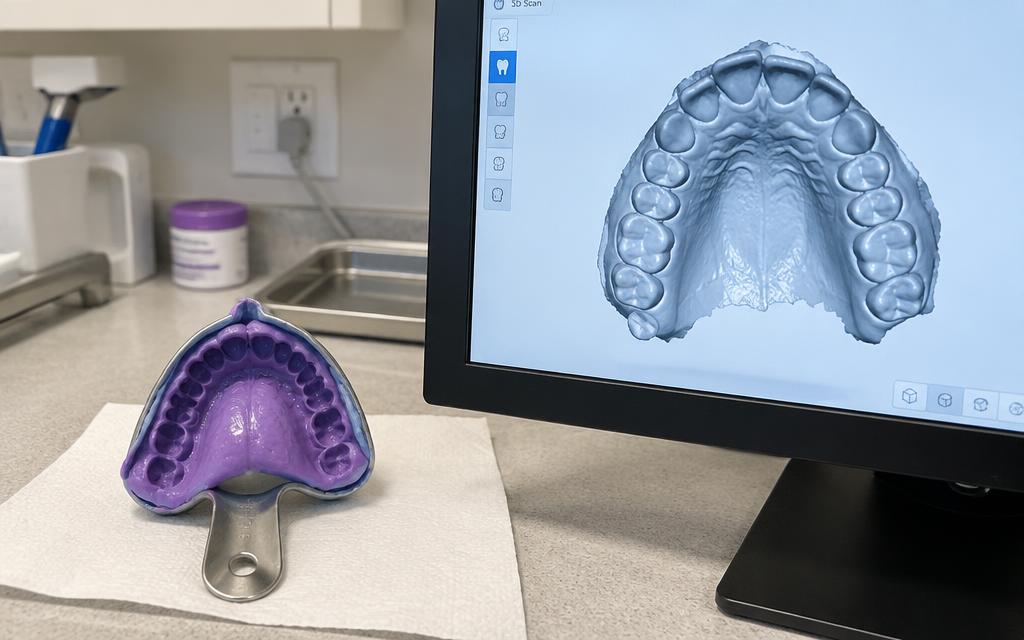
The shift from traditional impressions to digital workflows has fundamentally changed how crowns are designed, manufactured, and delivered. Digital crowns consistently achieve a more precise fit because they are built on accurate, distortion-free scan data rather than physical impression materials that are prone to error.
In a digital workflow, every step from impression capture to crown fabrication is based on high-resolution 3D data. This precision directly improves margin integrity, occlusal accuracy, and contact strength, resulting in crowns that seat more predictably and require fewer chairside adjustments.
Limitations of Traditional Impression Techniques
Traditional impressions rely on physical materials that introduce multiple opportunities for distortion. Tray movement, material shrinkage, improper seating, and model pouring variability can all affect the final restoration, even when the impression appears acceptable at chairside.
These variables often remain undetected until the crown is tried in, at which point adjustments or remakes may be required. Additionally, traditional impressions provide no immediate feedback on margin clarity or data completeness, making it difficult to correct errors early in the process.
As a result, crown fit becomes less predictable, particularly for restorations that demand high marginal accuracy.
How Digital Impressions Improve Crown Accuracy
Digital impressions eliminate many of the inconsistencies associated with analog techniques by creating a direct, three-dimensional representation of the prepared tooth. Intraoral scanners capture surface detail, margin geometry, and occlusal relationships in real time, allowing clinicians to verify accuracy before cases are submitted.
This immediate feedback enables:
-
Clear visualization of preparation margins
-
Identification of missing or distorted data
-
Accurate bite registration
Because the digital impression becomes the single source of truth for design and manufacturing, downstream steps are far more consistent than those based on physical models.
The Role of CAD in Crown Fit and Precision
Computer-aided design (CAD) systems rely entirely on the quality of the digital impression. When scan data is accurate, CAD software can precisely define margins, occlusal anatomy, and emergence profiles without excessive manual correction.
This precision allows crowns to be designed to match the patient’s anatomy rather than approximating it. Compared to traditional workflows, CAD-driven design significantly reduces variability between cases and operators, leading to more consistent fit outcomes.
For materials such as zirconia, where marginal accuracy is critical, this level of control is especially important.
How CAM Improves Consistency in Crown Manufacturing
Computer-aided manufacturing (CAM) complements digital design by producing restorations directly from validated CAD data. Milling and other digital fabrication methods create crowns that closely match the intended design, minimizing discrepancies introduced during manufacturing.
Unlike traditional techniques that rely on manual waxing or casting, CAM processes produce repeatable results across cases. This consistency improves seating accuracy and reduces the likelihood of adjustments caused by manufacturing variation.
Improved Workflow and Fewer Clinical Adjustments
One of the most practical advantages of digital crowns is how smoothly they move through the restorative workflow. Accurate scan data reduces interruptions during design, limits back-and-forth with the lab, and minimizes remakes caused by impression errors.
From a clinical standpoint, this translates into:
-
Crowns that seat with minimal adjustment
-
Reduced chair time during delivery appointments
-
More predictable scheduling and turnaround times
For patients, fewer adjustments mean shorter visits, improved comfort, and greater confidence in the final restoration.
Patient Comfort and Experience
Beyond fit accuracy, digital impressions significantly improve the patient experience. Eliminating traditional impression materials reduces gag reflex, discomfort, and anxiety, especially for patients with strong sensitivities.
Digital workflows also shorten treatment timelines by reducing the likelihood of remakes and delays. When crowns fit as intended, patients benefit from faster completion and more comfortable appointments.
Digital Crowns as the Standard for Predictable Fit
Digital crowns fit better than those produced from traditional impressions because they are built on precise, verifiable data rather than approximations. Digital impressions, combined with CAD/CAM workflows, reduce distortion, improve margin accuracy, and create restorations that seat more predictably.
As digital dentistry continues to evolve, these workflows are becoming the standard for achieving consistent crown fit, improved efficiency, and better patient outcomes.
For additional guidance on crown materials, restorative planning, and long-term performance considerations, explore our Dental Education Hub, where related topics are covered in greater depth to support informed clinical decision-making and predictable restorative outcomes.
Looking for more? Browse our full library of dental education resources.
Back to Education Center