Why Intraoral Scanner Accuracy Matters for Crown Fit
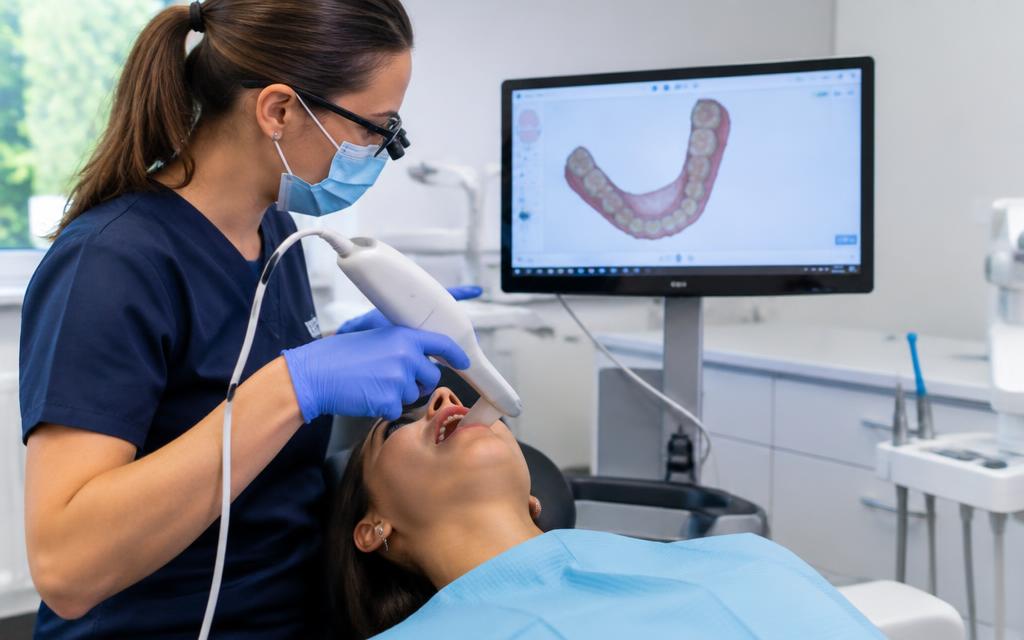
Intraoral scanner accuracy plays a critical role in the success of modern crown restorations. In a fully digital workflow, the quality of the initial scan directly determines how well a crown fits at the margins, contacts, and occlusion. Even minor inaccuracies in digital impressions can compound downstream, leading to seating issues, occlusal adjustments, or remakes.
As dentistry continues to move away from traditional impressions, scan accuracy has become one of the most important variables influencing crown predictability. A precise digital impression provides the foundation for reliable CAD design, accurate milling, and consistent clinical outcomes.
How Scan Precision Influences Crown Fit
Crown fit depends on the scanner’s ability to accurately capture fine surface detail, especially at preparation margins and interproximal areas. Poor scan data can introduce distortion, incomplete margin capture, or stitching errors, all of which compromise fit.
High-accuracy intraoral scanners reduce these risks by:
-
Capturing consistent surface geometry across the entire preparation
-
Maintaining dimensional stability throughout the scan
-
Accurately stitching multiple images without introducing artifacts
When scan data is precise, crowns are more likely to seat fully without binding, require fewer occlusal adjustments, and maintain proper contact strength. In contrast, inaccurate scans often lead to crowns that rock, bind, or seat high, even when the design and material are otherwise sound.
Digital Impressions vs Traditional Impressions
Digital impressions offer clear advantages over traditional impression materials when it comes to accuracy and repeatability. Conventional impressions are subject to material distortion, voids, improper tray seating, and inconsistencies during pouring and model fabrication.
Digital impressions eliminate many of these variables by creating a direct, three-dimensional representation of the preparation. This allows both the dentist and the dental lab to evaluate scan quality immediately, rather than discovering errors later in the process.
From a crown fabrication standpoint, digital impressions:
-
Reduce variability introduced by physical materials
-
Allow immediate verification of margin capture
-
Improve consistency across cases and operators
As a result, digital impressions support a more predictable crown workflow, particularly for zirconia restorations where marginal accuracy is critical.
Ensuring Margin Integrity Through Accurate Scanning
Margin integrity is one of the most common failure points in crown restorations, and scan accuracy plays a central role in preserving it. If margins are not clearly captured during scanning, the design process becomes a compromise, often relying on estimation rather than data.
Accurate intraoral scanning improves margin integrity by:
-
Clearly defining preparation edges
-
Capturing subgingival detail when tissue management is adequate
-
Providing clean data for CAD margin tracing
When margins are well captured, crowns exhibit better seal, reduced risk of cement washout, and improved long-term performance. Inaccurate or incomplete margin data, on the other hand, increases the likelihood of open margins, over-contoured crowns, or premature failure.
The Role of CAD/CAM in Crown Accuracy
CAD/CAM technology relies entirely on the quality of the digital impression. Precise scan data allows design software to accurately model crown anatomy, emergence profiles, and occlusal relationships. When scan data is distorted or incomplete, even the most advanced CAD/CAM systems cannot compensate fully.
Accurate scans enable:
-
Reliable crown design with minimal manual correction
-
Predictable milling outcomes
-
Consistent fit across different materials and case types
In a digital lab workflow, accurate scanning reduces the need for post-design adjustments and remakes, improving efficiency for both the dental office and the laboratory.
Workflow Efficiency in a Digital Crown Process
Accurate intraoral scanning improves more than just crown fit. It also enhances overall workflow efficiency by reducing interruptions, redesigns, and remakes. When scans are accurate from the start, cases move more smoothly through design, manufacturing, and delivery.
A well-executed digital workflow allows:
-
Faster turnaround times
-
Fewer chairside adjustments
-
More consistent communication between dentist and lab
This efficiency benefits patients through shorter appointments and more comfortable restorations, while practices benefit from reduced chair time and improved predictability.
Practical Considerations for Maximizing Scan Accuracy
To achieve consistent crown accuracy, scanning protocols matter as much as the scanner itself. While scanning technique is critical, the capabilities and limitations of different Intraoral Scanners also influence how consistently accurate scan data can be captured. Proper isolation, tissue management, and scan strategy all influence the final result. Even high-end scanners can produce poor data if scanning technique is inconsistent.
Best practices include:
-
Ensuring clear visibility of margins before scanning
-
Using systematic scan paths to avoid stitching errors
-
Verifying scan completeness before submitting cases
When scanning protocols are optimized, digital impressions become a reliable foundation for crown fabrication rather than a source of variability.
Intraoral Scanning as a Cornerstone of Digital Dentistry
Intraoral scanner accuracy is not an isolated technical detail. It is a cornerstone of digital dentistry and a prerequisite for predictable crown outcomes. Accurate digital impressions support better margin integrity, improved occlusal fit, and smoother CAD/CAM workflows.
Within a fully digital dental ecosystem, scanning accuracy directly influences the quality of zirconia crowns and other restorations. As digital workflows continue to evolve, the importance of precise intraoral scanning will only increase, reinforcing its role as a foundational step in modern restorative dentistry.
For additional guidance on crown materials, restorative planning, and long-term performance considerations, explore our Dental Education Hub, where related topics are covered in greater depth to support informed clinical decision-making and predictable restorative outcomes.
Looking for more? Browse our full library of dental education resources.
Back to Education Center