
Zirconia crowns are widely used in modern restorative dentistry due to their strength, durability, and ability to achieve highly natural aesthetics. The manufacturing process, from initial scanning to final sintering, involves a series of precise and controlled steps that directly influence the fit, strength, and appearance of the final restoration.
Each stage in this workflow plays a critical role in producing a high-quality zirconia crown that meets both functional and esthetic requirements.
Digital Scanning: Capturing Accurate Tooth Anatomy
The process begins with digital scanning, which captures a highly accurate representation of the prepared tooth and surrounding anatomy. These digital impressions replace traditional physical molds and provide a precise foundation for crown design.
Accurate scans are essential for:
-
Achieving proper marginal fit
-
Reducing chairside adjustments
-
Minimizing remakes
High-quality scans allow clinicians and laboratories to work from consistent, detailed data, improving predictability throughout the fabrication process.
Crown Design Using CAD Software
Once the scan is complete, CAD software is used to design the zirconia crown. This step allows for precise control over crown anatomy, occlusion, contact points, and material thickness.
Design considerations include:
-
Occlusal clearance and functional load
-
Margin placement and emergence profile
-
Esthetic contouring based on tooth position
Careful digital design ensures the crown will seat properly and perform reliably once placed.
Milling the Zirconia Crown
After design approval, the crown is milled from a pre-sintered zirconia block. At this stage, the material is relatively soft, allowing milling machines to accurately shape the crown without introducing microfractures.
The milled crown appears oversized and lighter in color due to the pre-sintered state of the zirconia. This intermediate stage is critical, as dimensional accuracy must account for shrinkage that occurs during sintering.
The Sintering Process Explained
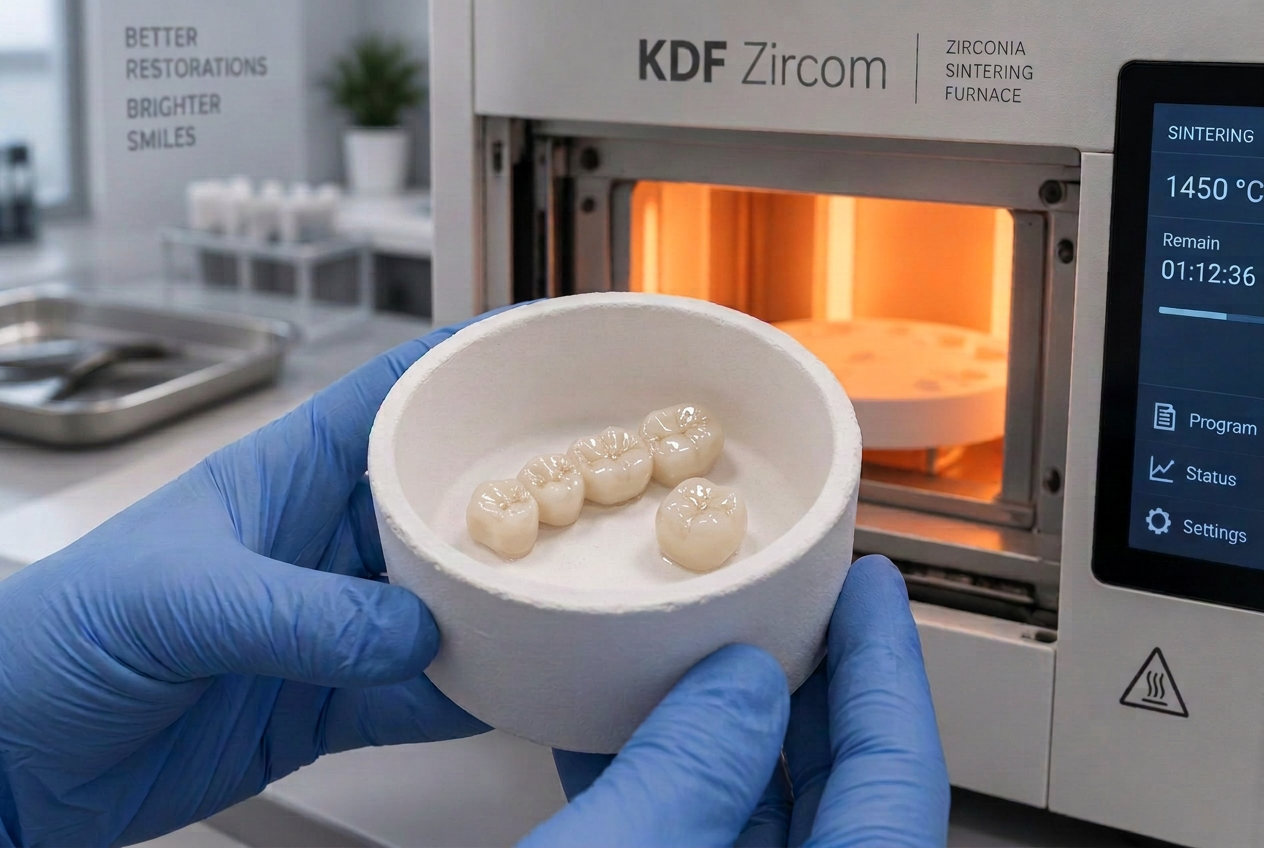
Sintering is the final and most transformative step in zirconia crown fabrication. During sintering, the crown is placed in a high-temperature furnace where it is heated to precise temperatures for a controlled period of time.
This process:
-
Densifies the zirconia material
-
Increases strength and fracture resistance
-
Achieves final dimensions and fit
-
Enhances translucency and color development
Proper temperature control and sintering cycles are essential. Variations can affect strength, aesthetics, and long-term performance.
Impact of Sintering on Strength and Aesthetics
Sintering directly influences the final properties of a zirconia crown. When performed correctly, the crown exhibits high durability while maintaining natural optical characteristics.
Key outcomes of proper sintering include:
-
Improved translucency that mimics natural enamel
-
High resistance to chipping and fracture
-
Stable color and surface quality
The sintering stage ultimately determines whether the crown meets clinical expectations for both function and appearance.
Achieving Esthetic Quality in Zirconia Crowns
Esthetics in zirconia restorations depend on multiple factors, including material selection, design parameters, and post-sintering finishing. Shade selection and translucency levels must align with the clinical indication and tooth position.
Anterior restorations often require higher translucency to replicate natural light transmission, while posterior crowns prioritize strength. Understanding these differences allows clinicians to select zirconia materials that balance aesthetics and durability.
Evaluating Zirconia for Clinical Applications
Not all zirconia materials are identical. Differences in translucency, grain structure, and strength make certain zirconia options better suited for specific cases.
When evaluating zirconia for a restoration, clinicians should consider:
-
Tooth location and functional load
-
Aesthetic requirements
-
Occlusal dynamics
-
Long-term durability expectations
Matching material properties to clinical demands supports predictable outcomes and long-lasting restorations.
From Scan to Sintering: A Controlled Process
The fabrication of zirconia crowns is a highly controlled process where each step builds upon the previous one. Accurate scanning, precise design, careful milling, and properly executed sintering all contribute to the final restoration’s success.
For additional educational resources covering zirconia materials, crown fabrication, and restorative planning, visit our Dental Education Hub, where related topics are organized to support informed clinical decision-making and long-term restorative success.
Looking for more? Browse our full library of dental education resources.
Back to Education Center