
Accurate crown margin capture is one of the most critical steps in restorative dentistry. Even with advanced intraoral scanners, poorly captured margins remain a leading cause of crown remakes, seating issues, and compromised long-term outcomes. Digital impressions offer significant advantages over traditional techniques, but those benefits are only realized when scanning is executed correctly.
Effective margin capture depends on a combination of proper preparation visibility, scanning technique, and verification before case submission. When margins are clearly and accurately recorded, restorations fit more predictably, require fewer adjustments, and perform better over time.
Why Crown Margin Capture Matters in Digital Dentistry
Crown margins define the interface between the restoration and the tooth. If margins are incomplete, distorted, or obscured in the digital impression, the design process becomes an approximation rather than a precise replication of the preparation.
In a digital workflow, the scanner replaces physical impression material as the source of truth. This makes margin accuracy even more important. CAD software cannot compensate for missing or unclear data, and laboratories are forced to estimate margin location when scan quality is insufficient. The result is often open margins, over-contoured crowns, or seating discrepancies.
Clear margin capture is foundational to predictable crown fit, especially for zirconia restorations where marginal accuracy directly affects longevity.
Preparing the Tooth for Successful Margin Scanning
Margin capture begins before the scanner is activated. No scanning technique can compensate for margins that are obscured by tissue, fluid, or inadequate preparation design.
Effective preparation for scanning includes:
-
Ensuring margins are clearly visible and accessible
-
Managing soft tissue to expose subgingival margins when present
-
Controlling moisture to prevent scan distortion or data loss
Proper tissue management and isolation allow scanners to accurately record the full margin geometry, reducing the risk of incomplete data.
Scanning Technique for Accurate Margin Detection
Once the preparation is ready, scanning technique becomes the primary determinant of margin accuracy. Controlled, deliberate movements produce better data than fast or inconsistent scan paths.
Maintaining a steady hand and consistent scanner orientation helps prevent stitching errors and tracking loss. The scanner tip should closely follow the contours of the preparation, with particular attention paid to the margin area. Overlapping scan passes ensure continuity of data and reduce the likelihood of missed areas.
Slowing down at the margins is especially important. Margins often require additional passes from multiple angles to fully capture their geometry, particularly in areas with limited visibility.
Verifying Margin Accuracy Before Submission
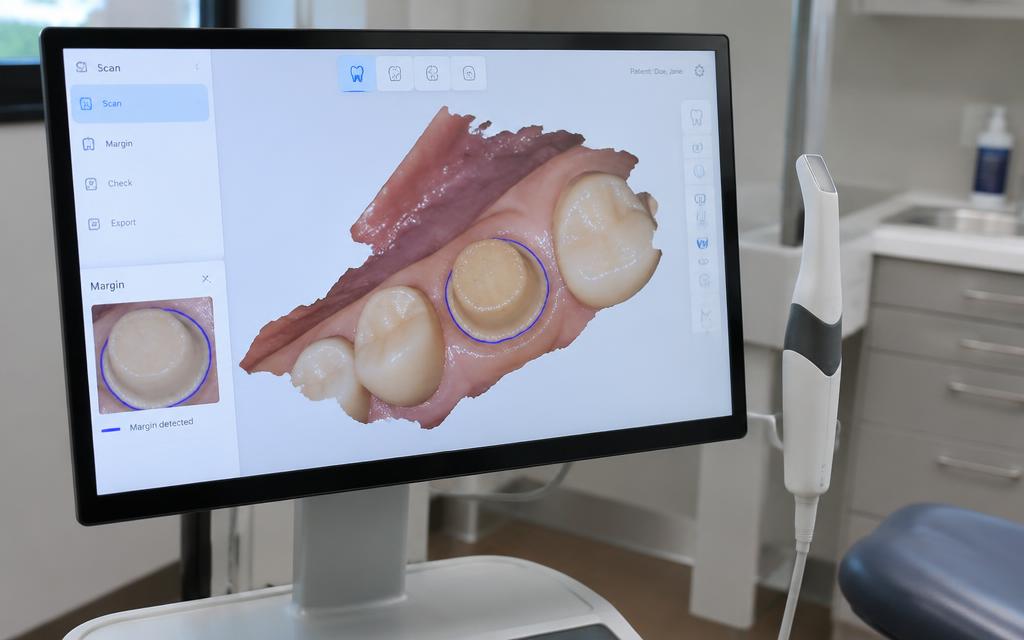
One of the most effective ways to prevent margin-related remakes is verifying scan quality before sending cases to the lab. Digital workflows allow clinicians to evaluate margin clarity immediately rather than discovering issues after fabrication has begun.
Verification should include:
-
Confirming continuous, clearly defined margins
-
Checking for holes, artifacts, or incomplete data near the margin
-
Reviewing the scan from multiple viewing angles
If margins are unclear, rescanning chairside is faster and more reliable than attempting to correct issues later in the workflow.
The Role of Software and Calibration
Scanner software plays a supporting role in margin capture, but it cannot replace good technique. Software tools may enhance visualization or assist with margin detection, but they depend entirely on the quality of the underlying scan data.
Regular scanner calibration ensures dimensional accuracy and consistent performance over time. Calibration should be performed according to manufacturer guidelines, particularly if scan quality appears inconsistent across cases.
Keeping both hardware and software updated helps maintain reliable margin capture and reduces variability between scans.
Communication With the Dental Lab
Clear communication between the dental office and the laboratory further improves margin accuracy. When labs can provide feedback on scan quality, potential issues can be identified early and corrected before fabrication proceeds.
Aligning expectations around margin visibility, scan verification, and submission standards leads to fewer delays and more predictable restorations.
Crown Margin Capture as a Skill, Not Just a Technology
Intraoral scanners are powerful tools, but margin accuracy ultimately depends on how they are used. Successful crown margin capture is a skill that combines preparation design, tissue management, scanning technique, and verification.
When margins are captured accurately, digital workflows deliver on their promise of better-fitting crowns, fewer remakes, and improved patient outcomes. As digital dentistry continues to evolve, mastering margin capture remains one of the most important competencies for predictable restorative success.
For additional guidance on crown materials, restorative planning, and long-term performance considerations, explore our Dental Education Hub, where related topics are covered in greater depth to support informed clinical decision-making and predictable restorative outcomes.
Looking for more? Browse our full library of dental education resources.
Back to Education Center