
Digital impressions are a cornerstone of modern restorative dentistry, but accuracy is not guaranteed by technology alone. Even with advanced intraoral scanners, common scanning errors can compromise crown fit, occlusion, and margin integrity if proper technique and protocols are not followed.
Understanding where digital impressions fail and how to prevent those failures is essential for achieving predictable restorative outcomes. Most issues originate not from the scanner itself, but from scanning technique, environmental conditions, and incomplete verification before case submission.
The Most Common Digital Impression Errors
Digital impression errors typically fall into a few repeatable categories. Recognizing these early helps prevent downstream complications during design and fabrication.
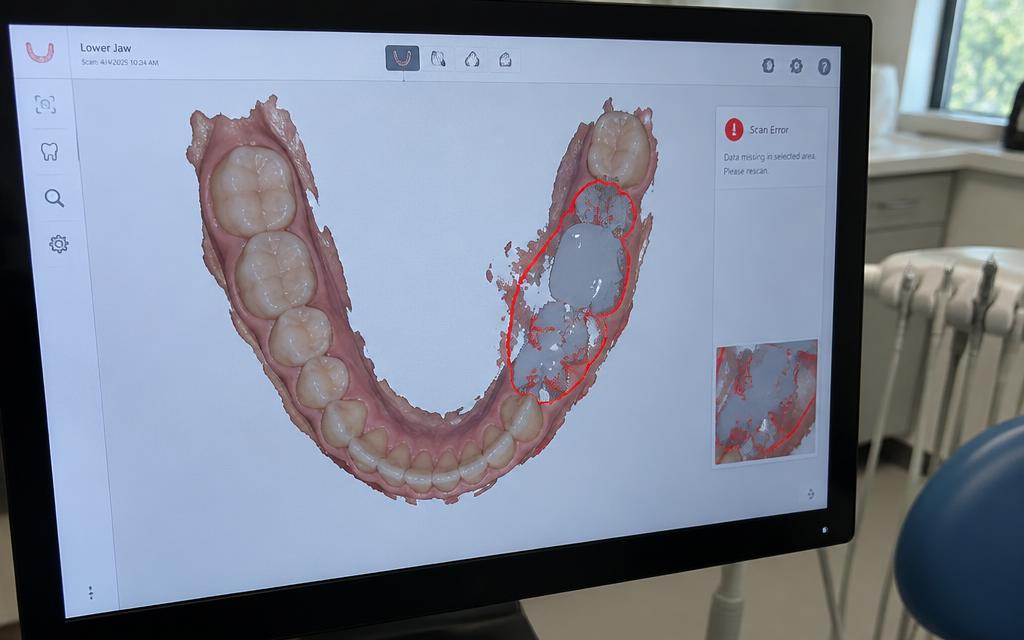
One of the most frequent issues is incomplete data capture, particularly at preparation margins or interproximal areas. Missed or poorly defined margins force the lab to estimate design boundaries, increasing the risk of open margins or over-contoured restorations.
Another common problem is stitching distortion. Inconsistent scan paths, abrupt movements, or loss of tracking can introduce subtle warping that affects occlusal relationships and contact strength. These distortions may not be obvious chairside but often become apparent when crowns do not seat fully.
Occlusal discrepancies are also frequently traced back to scanning errors, such as improper bite capture or patient movement during the scan. Without a stable and accurate occlusal record, even well-designed restorations may require chairside adjustment.
Why Technique Matters as Much as Technology
While scanner capabilities influence accuracy, operator technique plays an equally important role. Inconsistent angulation, variable scan distance, or rushing through critical areas can all degrade scan quality.
Effective scanning technique emphasizes controlled, methodical movements and consistent overlap between passes. Maintaining scanner orientation and avoiding abrupt direction changes reduces the risk of tracking loss and distortion. Equally important is verifying scan completeness before submission, rather than assuming errors can be corrected later.
Routine calibration of scanning devices also supports accuracy. Calibration ensures dimensional consistency and helps minimize cumulative errors that can affect fit over time.
Environmental and Workflow Factors That Affect Accuracy
Digital impression accuracy can also be influenced by factors beyond scanning technique. Inadequate isolation, saliva contamination, and poor tissue management can obscure margins and surface detail, even when the scan itself is technically sound.
Environmental consistency matters as well. Stable lighting conditions and controlled operatory environments help reduce scan artifacts and improve surface capture. While digital systems eliminate many variables associated with traditional impressions, they still rely on clean, visible data to function effectively.
Establishing standardized scanning protocols within a practice helps reduce variability between operators and cases. Clear expectations around margin visibility, bite verification, and scan review improve consistency and reduce the likelihood of remakes.
Verifying Accuracy Before Case Submission
One of the most effective ways to prevent digital impression errors is thorough verification before submitting cases to the lab. Reviewing scans for margin clarity, occlusal completeness, and data continuity allows errors to be corrected immediately, rather than discovered after design or milling has begun.
Verification should include:
-
Confirming that all preparation margins are clearly visible
-
Checking for holes, artifacts, or stitching errors
-
Ensuring accurate occlusal relationships and bite registration
This step adds minimal time to the workflow but significantly improves restoration predictability.
Improving Outcomes Through Lab Communication
Clear communication between the dental office and the digital lab further reduces the impact of scanning errors. Providing feedback loops allows labs to flag questionable scan data early and request clarification before fabrication begins.
When scanning protocols and expectations are aligned, labs can design restorations more confidently, reducing manual adjustments and improving consistency across cases.
Digital Impressions as a Foundation for Predictable Restorations
Digital impressions offer significant advantages over traditional techniques, but accuracy depends on execution. Most digital impression errors are preventable through proper scanning technique, environmental control, verification protocols, and effective communication with the lab.
By addressing these common pitfalls, dental teams can fully leverage digital dentistry workflows, resulting in better-fitting restorations, fewer adjustments, and more predictable long-term outcomes.
For additional guidance on crown materials, restorative planning, and long-term performance considerations, explore our Dental Education Hub, where related topics are covered in greater depth to support informed clinical decision-making and predictable restorative outcomes.
Looking for more? Browse our full library of dental education resources.
Back to Education Center