
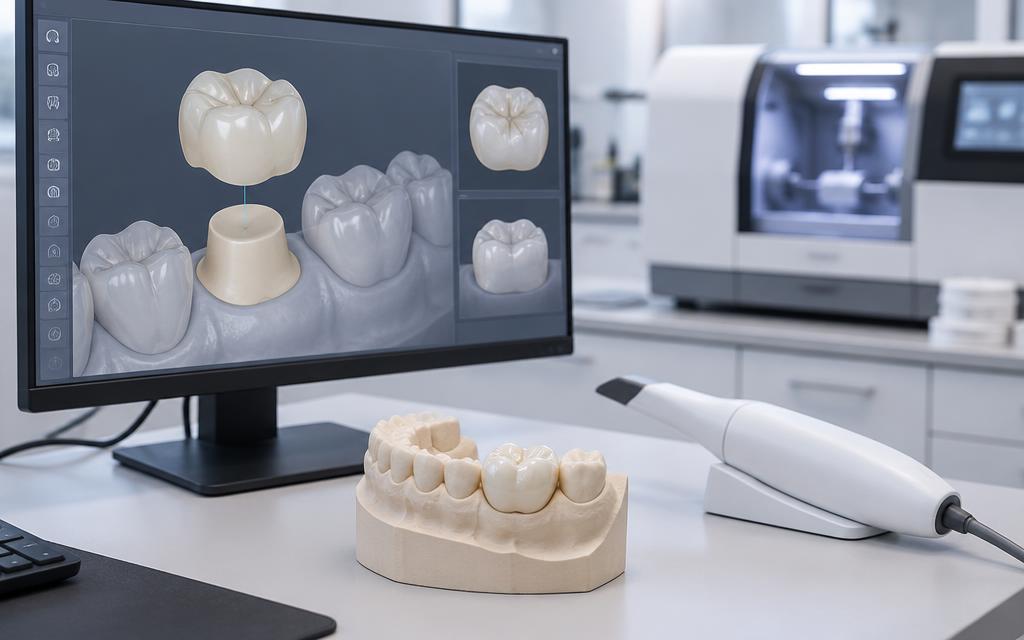
CAD/CAM dentistry has transformed how crowns are designed and manufactured by replacing manual, analog steps with a fully digital workflow. From intraoral scanning to final crown fabrication, each stage builds on precise digital data, resulting in restorations that fit more predictably and are delivered more efficiently.
Understanding this workflow helps clarify why digital crowns consistently outperform those produced through traditional impression and fabrication methods.
Step 1: Digital Impression Capture
The CAD/CAM workflow begins with a digital impression captured using an intraoral scanner. Unlike traditional impression materials, digital scans create a direct three-dimensional model of the prepared tooth, surrounding dentition, and occlusion.
This step is critical. The scan becomes the foundation for every downstream process, including design and manufacturing. Clear margin capture, accurate occlusal registration, and complete data coverage ensure the crown can be designed without estimation or correction later in the workflow.
Digital impressions also allow clinicians to verify scan quality immediately, reducing the risk of errors that would otherwise surface after fabrication has begun.
Step 2: CAD Design and Margin Definition
Once the digital impression is captured, the scan data is imported into CAD software for crown design. During this stage, margins are identified, occlusal anatomy is defined, and emergence profiles are shaped to match the patient’s anatomy.
Accurate scan data allows CAD software to work as intended. When margins are clearly captured, crown design requires minimal manual intervention. When scan data is incomplete or distorted, design becomes an approximation, increasing the risk of fit issues.
This step is where digital workflows offer a major advantage. CAD systems maintain dimensional consistency and allow for precise adjustments that are difficult to achieve in analog workflows.
Step 3: CAM Manufacturing and Milling
After the crown design is finalized, the file moves into the CAM phase, where the restoration is manufactured. For crowns, this typically involves milling the restoration from a solid block of material, such as zirconia.
Because CAM systems fabricate directly from validated CAD data, the resulting crown closely matches the digital design. This consistency reduces variability between cases and limits the need for manual adjustments after manufacturing.
For zirconia crowns, this step also includes sintering, where the material is densified to achieve final strength and fit.
Step 4: Finishing, Quality Control, and Delivery
Once milling and sintering are complete, the crown is finished, inspected, and prepared for delivery. Digital workflows simplify quality control by allowing technicians to compare the finished restoration directly against the original digital design.
Because each step in the process is based on the same dataset, discrepancies are easier to identify and correct. The result is a crown that seats more predictably and requires fewer chairside adjustments.
How CAD/CAM Improves Efficiency and Predictability
The primary advantage of the CAD/CAM workflow is not speed alone, but predictability. Each step builds on accurate digital data, reducing cumulative errors that are common in traditional workflows.
For dental practices and labs, this means:
-
Fewer remakes caused by impression distortion
-
More consistent crown fit
-
Reduced chairside adjustment time
-
Improved communication between the clinic and the lab
Efficiency improves as a byproduct of accuracy, not at the expense of quality.
Aesthetic Outcomes in Digital Crown Fabrication
Digital workflows also support improved aesthetic outcomes. CAD design allows restorations to be customized for anatomy, occlusion, and emergence profile with a level of precision that is difficult to replicate manually.
When combined with modern materials such as zirconia, digital crowns can achieve both strength and natural appearance. The ability to control design parameters digitally results in restorations that balance function and aesthetics more consistently across cases.
The Role of 3D Printing in the Digital Workflow
While crown fabrication typically relies on milling, 3D printing plays a growing role in the broader CAD/CAM ecosystem. Printed models, provisionals, and surgical guides are commonly produced using the same digital impression data.
This integration further streamlines workflows and reinforces the value of accurate scanning at the beginning of the process. When digital data is reliable, it can be reused across multiple applications without introducing additional error.
Why the Digital Workflow Matters
The CAD/CAM workflow replaces variability with consistency. By maintaining a single digital dataset from scan to final crown, the restorative process becomes more controlled and predictable.
Digital dentistry does not eliminate the need for skill or clinical judgment, but it reduces the number of variables that can compromise outcomes. As a result, crowns fit better, appointments run more smoothly, and patients experience more reliable restorative care.
For additional guidance on crown materials, restorative planning, and long-term performance considerations, explore our Dental Education Hub, where related topics are covered in greater depth to support informed clinical decision-making and predictable restorative outcomes.
Looking for more? Browse our full library of dental education resources.
Back to Education Center